Section outline
-
Students are introduced to the fundamentals of academic communication, including clarity, audience awareness, organization of ideas, and critical thinking strategies used in university contexts.
-
Welcome to Week 1
Welcome to the first week of Academic Writing and Speaking Skills! This week, you will explore what academic communication means and why it matters in university life. You will learn the core principles of clarity, audience awareness, and organization and discover how critical thinking shapes effective academic work.
By the end of this week, you will be able to:
• Define academic communication and explain how it differs from informal communication
• Identify the key features of clear, audience-appropriate academic language
• Apply basic critical thinking strategies to academic tasks
• Reflect on your own communication strengths and goals
Activities this week: Introductory video, readings, discussion forum, knowledge check quiz, and your first reflective journal entry.
First we will start with an inforgraphic:
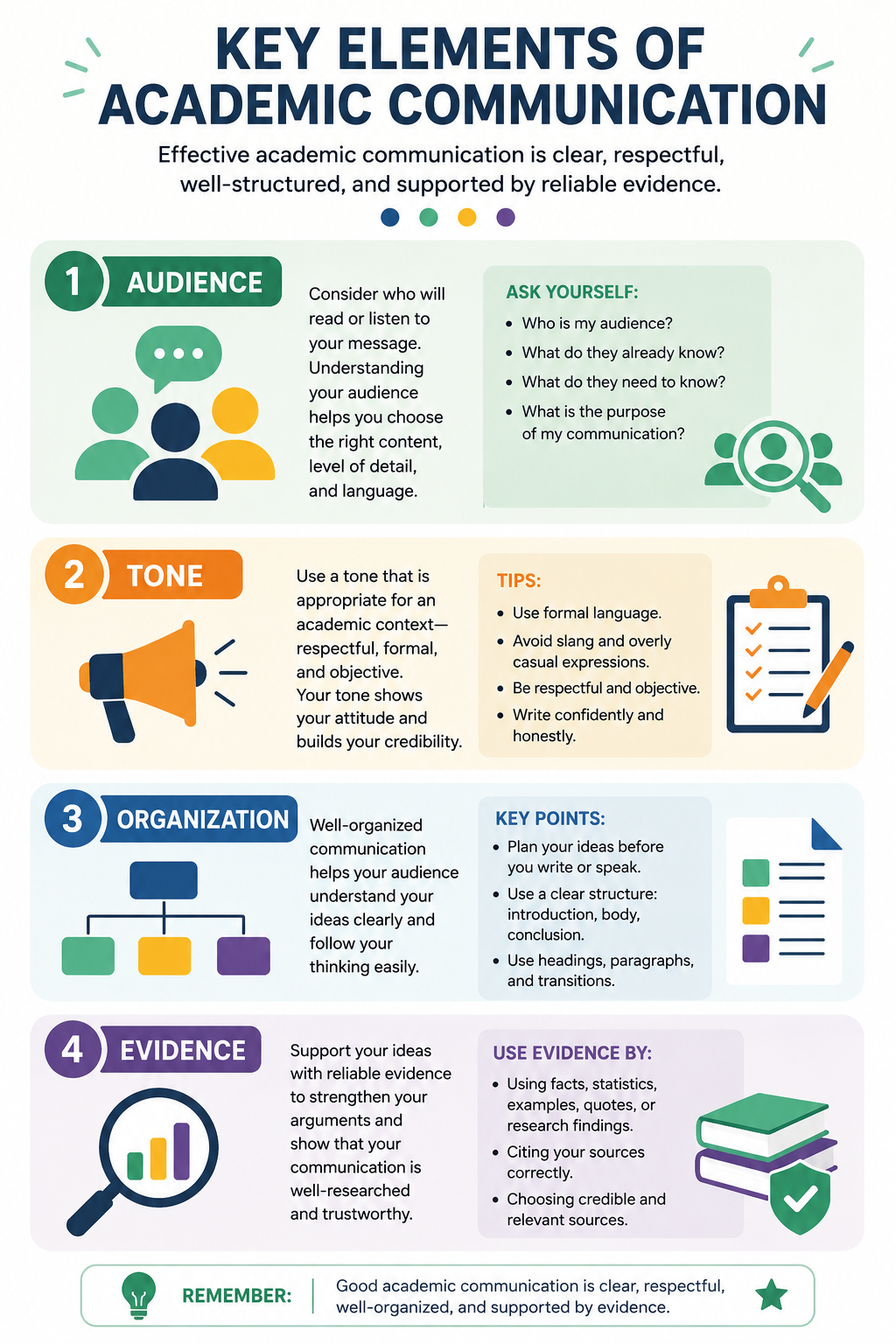
The image is an educational infographic titled “Key Elements of Academic Communication.” It explains the main components of effective academic communication using colorful sections, icons, and short explanations.
The infographic states that effective academic communication should be clear, respectful, well-structured, and supported by reliable evidence.
It is divided into four numbered sections:
1. Audience
This section focuses on understanding the people receiving the message.
It explains that knowing the audience helps choose the correct content, language, and level of detail.Questions included:
- Who is my audience?
- What do they already know?
- What do they need to know?
- What is the purpose of my communication?
Visuals:
- People icons
- Speech bubble
- Magnifying glass
2. Tone
This section explains that academic tone should be:
- Respectful
- Formal
- Objective
Tips provided:
- Use formal language
- Avoid slang and overly casual expressions
- Be respectful and objective
- Write confidently and honestly
Visuals:
- Megaphone
- Clipboard and checklist
3. Organization
This section highlights the importance of structuring ideas clearly.
Key points:
- Plan ideas before writing or speaking
- Use a clear structure: introduction, body, conclusion
- Use headings, paragraphs, and transitions
Visuals:
- Flowchart/organizational diagram
- Document icon
4. Evidence
This section emphasizes supporting ideas with reliable evidence.
Suggestions include:
- Use facts, statistics, examples, quotes, or research findings
- Cite sources correctly
- Choose credible and relevant sources
Visuals:
- Magnifying glass with charts
- Stack of books
- Shield/checkmark symbol
Then you can read the following document:
https://drive.google.com/file/d/1VdKW1FRQv7JEcXNj6yjlLqCWT2NNuXOi/view?usp=sharing
Here are the open access Resources:
Open-Access Resources
Video Resources
Academic Communication Basics (SkillsYouNeed): https://www.skillsyouneed.com/writing-skills/academic-writing.html
Introduction to Academic Writing (Coursera — free audit): https://www.coursera.org/learn/academic-writing
Critical Thinking at University (YouTube — LearnHigher):
Reading Resources
Academic Writing Guide — University of Adelaide (free PDF): https://www.adelaide.edu.au/writingcentre/sites/default/files/docs/learningguide-academicwriting.pdf
Critical Thinking — University of Plymouth guide: https://www.plymouth.ac.uk/uploads/production/document/path/1/1710/Critical_Thinking.pdf
Purdue OWL: Introduction to Academic Writing: https://owl.purdue.edu/owl/general_writing/academic_writing/index.html
-
-
-
-